
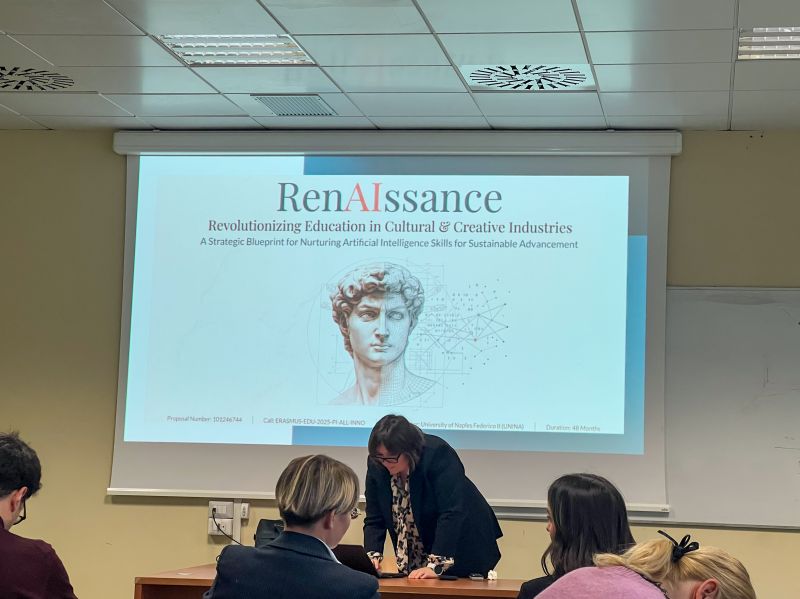
Revolutionizing education and nurturing AI skills for the cultural and creative industries
RenAIssance builds a transnational, AI-driven training framework so that AI-enhanced design education becomes an integral part of vocational and higher education across Europe: from skills intelligence to accredited curricula, pilots and policy.
- Programme
- Erasmus+ Alliances for Innovation · Blueprint for sectoral cooperation on skills
- Call · topic
- ERASMUS-EDU-2025-PI-ALL-INNO · BLUEPRINT
- Grant agreement
- 101246744 (lump sum)
- Duration
- 48 months · 1 Dec 2025 – 30 Nov 2029
- EU contribution
- € 3.99 million
- Coordinator
- University of Naples Federico II (CeSMA) · Prof. Flora Amato
- Consortium
- 12 partners · 8 EU countries
- Qualification levels
- EQF 3 – 8 · ESCO-aligned profiles · micro-credentials
A widening AI skills gap in European design
Generative design, computational creativity and AI-assisted fabrication are becoming industry standards in product design, architecture, fashion and craftsmanship. Yet most vocational and higher education programmes in these material-associated design disciplines have not incorporated AI-driven methodologies. The sector is caught between fast-moving tools and slow-moving curricula.
The numbers are stark. According to the Creative Pact for Skills (2025), 77.4% of cultural and creative industry stakeholders see AI integration as critical to growth, but 30.3% of design firms lack personnel with AI expertise, 36.1% cite high implementation costs and 69% point to limited access to funding. 78% of employers report difficulty recruiting design professionals with AI expertise (PEC, 2024). Freelancers and small creative enterprises, the backbone of European design, face barriers in accessing AI training that increase job precarity.
The risk is not only economic. Uncritical use of AI can flatten aesthetic diversity: models average their training data, systems trained on AI-generated content progressively impoverish creative output, and recommendation algorithms create echo chambers. In material disciplines, generative tools often ignore structural constraints, material properties and real production processes. RenAIssance starts from the premise that the question is not whether AI should be used in art and culture, but how: AI must be an extension of human capability rather than a substitute, and design education must teach that difference.
Five gaps the project addresses
- Limited AI literacy in design education
- No structured training pathways in AI-driven generative design, advanced personalisation and digital fabrication
- Fragmentation between traditional craftsmanship and AI-enhanced design workflows, which holds back small creative enterprises and independent designers
- Absence of AI-powered sustainability frameworks for material optimisation, circular design and eco-conscious production
- Cognitive biases in AI applications for design, calling for a humanistic, ethical approach
What RenAIssance sets out to achieve
The core objective is a transnational AI-driven training framework that equips designers, architects and digital creators with future-proof skills, so that AI-enhanced design education becomes an integral part of both vocational and higher education systems across Europe. Through an approach that is practical, hybrid, interactive and inclusive, the project will provide:
- A structured, sector-wide strategy to integrate AI into design education and professional development, addressing current and future skill demands.
- An immediate impact on design education and training by addressing urgent AI skills shortages in the first year.
- A collaborative network of VET providers, higher education institutions and industry stakeholders that keeps training industry-relevant.
- Cross-border knowledge exchange and best practices, harmonising AI design training across EU Member States.
- A scalable and sustainable framework that national education systems can adopt and incorporate into long-term skills policies.
- An AI-empowered workforce able to drive innovation in product design, architecture, fashion and digital media, to design sustainably, and to have AI-based design qualifications formally recognised across Europe.
Eight specific objectives
Develop a sector-wide AI skills strategy for the design domain of the CCI ecosystem
A validated skills strategy aligned with ESCO, EQF and the Pact for Skills, built on the Urgent AI Skills Gap Report, shaped in the CCIs Skills Strategy and Roadmap and consolidated in a transnational AI Competence Framework.
Design and pilot AI-enhanced training modules in VET and HE
Modular AI-driven training programmes covering EQF levels 3–8, piloted across at least eight EU countries and assessed for learning outcomes, industry validation and learner feedback.
Define and validate AI-driven occupational profiles and competencies
Updated occupational profiles for the design domain, formally validated by industry and accreditation bodies, from the AI-Guided Prototyping Technician (EQF 5) to the Computational AI Designer (EQF 8).
Address urgent AI skills gaps and deploy rapid training
Short intensive courses delivered by VET providers, universities and online platforms within the first twelve months, planned in three formats of one, two and three months.
Build a transnational AI training ecosystem for design
A large-scale partnership of VET providers, higher education, industry and policymakers, with a governance framework and an AI Education and Training Toolkit, that keeps training relevant beyond the project.
Integrate AI-driven sustainable design frameworks into training
AI-driven material optimisation, life-cycle assessment and circular design as a core part of the curriculum, in line with the European Green Deal.
Ensure formal accreditation and long-term adoption
Certification standards aligned with ESCO, EQF and Europass Digital Credentials, so that AI learning pathways are stackable, transferable and recognised across Member States.
Introduce ethical AI and SME adoption strategies
Bias mitigation, transparency and responsible AI in creative processes, plus cost-effective adoption pathways, mentoring and tailored modules for SMEs and micro-enterprises, which make up at least 30% of pilot participants.
From skills intelligence to accredited training
A phased, evidence-based method that moves from foresight to classroom to policy: skills intelligence and strategy first, then modular curricula and new occupational profiles, transnational pilots in at least eight countries, and finally integration into European and national qualification frameworks. Hands-on learning is central: every module combines practical exercises, case studies or lab work, and every programme ends with a real creative-industry project.
Skills intelligence and foresight
A Foresight Committee of design, architecture, manufacturing, arts, academia, policy, AI and fabrication experts guides data collection across eight countries, structured around ESCO. Scenario planning produces four normative scenarios for the sector by 2035–2040 and feeds the CCIs Skills Strategy and Roadmap.
Rapid training for urgent gaps
In the first year, Rapid Training Packs address the most pressing shortages: planned as a one-month Fundamentals course, a two-month Applied AI course with an industry-mentored capstone, and a three-month Advanced course with specialisation tracks in architecture, product design, fashion or media.
Modular curricula and new profiles
Flexible learning pathways for VET and higher education, mapped to EQF levels and aligned with ESCO for cross-border recognition. Four example profiles anchor the offer: Computational AI Designer (EQF 8), Creative AI Expert (EQF 7), AI-Driven Idea Generation Designer (EQF 6) and AI-Guided Prototyping Technician (EQF 5).
Transnational pilots and work-based learning
Curricula piloted in at least eight VET and higher education institutions, combined with AI-powered work-based learning: AI learning labs, virtual and hybrid internships, XR environments and learning analytics. A train-the-trainer programme certifies educators; learners receive Europass Digital Credentials.
Responsible, green and inclusive by design
Training is supplemented with a module on data ethics and responsible AI (privacy, bias, transparency, human oversight) guided by the AI Act and GDPR. Green AI methodologies embed material optimisation, waste reduction and circular economy principles; gender-responsive, accessible design ensures equitable participation.
Accreditation, policy and sustainability
A roadmap for long-term adoption, mechanisms to integrate AI competences into national qualification frameworks, EQAVET- and ESG-based quality assurance, a sectoral partnership governance framework and a funding plan, channelled through the Pact for Skills, the European Digital Education Hub, EPALE and Europass.
Learners, educators, businesses and policymakers
VET learners and providers
Vocational students and institutions in the design domain gain AI-enhanced curricula, rapid training packs and Europass Digital Credentials.
Higher education
Universities, design schools and universities of applied sciences adopt modular AI-driven programmes and new occupational profiles.
Designers, architects, artisans, digital creators
Entry-level and mid-career professionals in product design, architecture, craftsmanship, fashion and digital media move into AI-augmented roles rather than being displaced.
SMEs and micro-enterprises
A dedicated SME track with cost-effective tools, mentoring and customised modules; at least 30% of pilot participants come from SMEs or micro-enterprises.
Trainers and educators
Certified through a train-the-trainer programme with micro-credentials, covering AI-driven workflows, generative design, AI-enhanced assessment and responsible AI.
Accreditation bodies
Engaged to recognise AI-enhanced training through ESCO, EQF and Europass Digital Credentials, making pathways stackable across Member States.
Policymakers and sectoral bodies
National and European decision-makers, skills councils and networks such as the Pact for Skills receive the strategy, policy briefs and a Policy Advocacy Toolkit.
Women and underrepresented groups
Inclusive, gender-responsive and accessible training design, flexible learning paths, scholarships and accessibility-enhanced digital environments; at least 70 participants from groups with fewer opportunities.
Seven work packages
Month 1 is December 2025. Calendar dates are indicative; deliverable codes follow the grant agreement. Public deliverables will be published on this site as they are released.
WP1Project management and coordination
The backbone of RenAIssance: planning and coordination of all activities, administration, financial supervision and reporting to the European Commission, and monitoring of progress, risks, quality and ethics across the consortium. A kick-off meeting, three further consortium meetings, quarterly online meetings and a shared Project Management Handbook give the twelve partners a clear framework.
Tasks
T1.1Project planning and administration (UNINA, M1–M48)T1.2Financial management of EU funding (UNINA, M1–M48)T1.3Project monitoring, risk management and ethics compliance (UNINA, M1–M48)
Deliverables
D1.1Project Management HandbookM3 · internalD1.2Monitoring, risk and ethics report (1st)M18 · internalD1.3Monitoring, risk and ethics report (2nd)M30 · internalD1.4Monitoring, risk and ethics report (3rd)M42 · internal
WP2AI-driven CCIs skills intelligence and sectoral strategy development
The knowledge foundation of the project. Enterprises, VET providers, universities, public authorities and social partners join a shared CCIs Cooperation Framework; the AI skills that design, architecture and digital fabrication will need are mapped in line with ESCO, EQF and Cedefop skills intelligence; the evidence becomes a public CCIs Skills Strategy and Roadmap, presented in five hybrid workshops across Europe.
Tasks
T2.1Stakeholder engagement and CCIs AI-driven design cooperation framework (NERDA, M1–M4)T2.2AI skills mapping for design, architecture and digital fabrication (NERDA, M3–M6)T2.3Development of the CCIs Skills Strategy (Medaarch, M6–M9)T2.4Stakeholder engagement and dissemination: five hybrid events (Medaarch, M9–M12)
Deliverables
D2.1Stakeholder Mapping ReportM2 · internalD2.2CCIs Cooperation FrameworkM4 · internalD2.3CCIs Skills Intelligence ReportM6 · publicD2.4CCIs Skills Strategy and RoadmapM9 · publicD2.5Dissemination and Engagement PlanM9 · internalD2.6Workshop reports and materials from the five eventsM12 · public
WP3Urgent AI skills gap analysis and rapid training deployment
The fast-response track. It pinpoints the AI competences that fashion, architecture, design and craftsmanship professionals need right now, designs short modular programmes around four areas (AI generative preview, AI in digital fabrication, AI in visual arts, AI-powered idea generation) and deploys them through VET providers, Centres of Vocational Excellence, universities and online platforms in at least eight countries. Learners receive Europass Digital Credentials and the evaluation refines the methodology for WP4.
Tasks
T3.1Identification of demonstrator projects for rapid AI-focused training (Medaarch, M1–M4)T3.2Design of short-term AI-focused upskilling and reskilling programmes (Elisava, M3–M6)T3.3Deployment of pilot rapid training sessions in VET and HE (Medaarch, M6–M10)T3.4Evaluation of training effectiveness and refinement for WP4 (Corallia, M11–M12)
Deliverables
D3.1Urgent AI Skills Gap ReportM4 · publicD3.2AI Rapid Training PlanM9 · internalD3.3AI Rapid Training Implementation ReportM10 · publicD3.4AI Urgent Skills Addressing ReportM12 · public
WP4AI-enhanced design curriculum and training development
The educational core. Lessons from the first year become modular curricula covering generative design, automation in design processes, predictive analytics and sustainability-driven AI, supported by AI-powered simulations, augmented-reality environments and online toolkits. Curricula are aligned with EQAVET, ESG, ESCO and Europass Digital Credentials so that learners earn stackable micro-credentials, and a train-the-trainer programme is tested with at least 40 trainers from eight Member States.
Tasks
T4.1Design and development of AI-driven curricula for design and AI-enhanced creativity (Elisava, M12–M18)T4.2Interactive learning materials, AI-powered simulations and online toolkits (Waag, M15–M21)T4.3Alignment of curricula with EQF levels 3–8 and European certification standards (UNINA, M18–M24)T4.4Train-the-trainer programme to support scalability (NERDA, M21–M24)
Deliverables
D4.1AI-Driven Curricula DevelopmentM18 · publicD4.2AI Education and Training ToolkitM21 · publicD4.3AI-driven Design Train-the-Trainer FrameworkM24 · publicD4.4Train-the-Trainer Pilot Activities ReportM24 · public
WP5AI training implementation and validation in HE, VET and industry
The curricula are put to the test where it matters: classrooms, labs and studios. Pilots in at least eight VET and higher education institutions across eight countries are followed by cross-border placements in creative enterprises, AI research labs, FabLabs and makerspaces. Every pilot issues preliminary certificates and micro-credentials mapped to ESCO and EQF; feedback from educators, students and industry feeds the final training models, a scalability plan and guidelines for SMEs.
Tasks
T5.1Piloting AI-integrated training in VET and HE institutions (UNINA, M24–M30)T5.2Work-based learning and industry placements for students and professionals (Corallia, M27–M36)T5.3Structured feedback from educators, students and industry partners (Corallia, M30–M39)T5.4Refinement of training models based on real-world validation data (UNINA, M36–M42)
Deliverables
D5.1AI Training Pilots Implementation ReportM30 · publicD5.2Work-Based Learning and Industry Placements ReportM36 · publicD5.3Final AI-Driven Training Models and Certification FrameworkM42 · public
WP6Impact and long-term exploitation
Making sure RenAIssance outlives its funding period. The stakeholder networks built in WP2 become formal sectoral partnerships; certification standards for AI competences in design are aligned with ESCO and EQF; a roadmap guides the roll-out of the strategy, curricula and training at local, national and EU level, with dedicated adoption strategies for SMEs. A funding strategy, a continuous improvement cycle with bi-annual curriculum reviews and policy advocacy with education ministries complete the long-term action plan.
Tasks
T6.1Strengthening and institutionalising sectoral partnerships (Waag, M24–M40)T6.2Development of AI skills certification standards (UNINA, M24–M48)T6.3Roadmap for roll-out and scalability (Medaarch, M40–M44)T6.4Financial sustainability and funding strategy (Iniziativa Cube, M42–M46)T6.5Strategy for continuous improvement and updates (Medaarch, M44–M48)T6.6Policy advocacy for AI integration in national education strategies (EfVET, M36–M48)
Deliverables
D6.1Sectoral Partnership Governance FrameworkM40 · publicD6.2AI Skills Certification Standards ReportM42 · publicD6.3Roll-out and Scalability RoadmapM44 · publicD6.4Financial Sustainability and Funding PlanM46 · publicD6.5Continuous Improvement and Update StrategyM48 · publicD6.6Policy Advocacy Toolkit for AI IntegrationM48 · public
WP7Communication and dissemination
Making sure results reach the people who can use them. A communication strategy and visual identity are in place by month 4; the project speaks through LinkedIn, X and Instagram, partner websites and newsletters, brochures, videos and press. At least one national dissemination event in every partner country, annual thematic webinars and European conferences such as the EfVET Annual Conference lead to a Final Conference in Naples. Targets include 500+ stakeholders reached, 1,000 social media followers and 12 press articles.
Tasks
T7.1Communication and dissemination strategy (EfVET with all partners, M1–M4)T7.2Digital and social media engagement (Turku University of Applied Sciences, M3–M48)T7.3Stakeholder engagement and dissemination events (EfVET, M6–M48)T7.4Production and dissemination of communication materials (Turku University of Applied Sciences, M6–M48)
Deliverables
D7.1Communication and Dissemination StrategyM4 · internalD7.2Project Branding KitM4 · publicD7.3Social Media Strategy and Content PlanM6 · internalD7.6Promotional Materials PackageM12 · publicD7.4Mid-term Communication and Dissemination ReportM24 · publicD7.7Multimedia Content PackageM24 · publicD7.5Final Conference and Stakeholder Event ReportM48 · public
Four years, seven phases
Each phase feeds the next: intelligence before curricula, rapid pilots before full pilots, validation before accreditation.
Milestones so far
- Kick-off meeting in Naples, 22–23 January 2026
- Cooperation Framework and Urgent AI Skills Gap Report (spring 2026)
- ALIGN and CO-DESIGN workshops and 97-stakeholder consultation (April–May 2026)
- CCIs Skills Intelligence Report and Skills Strategy (summer 2026)
- RenAIssance on stage at Creative Skills Week 2026, Brussels (September 2026)
Launch and set-up
Kick-off in Naples, Project Management Handbook, stakeholder mapping and Cooperation Framework, communication strategy and branding, Urgent AI Skills Gap Report.
Skills intelligence and sectoral strategy
AI skills mapping, Skills Intelligence Report, CCIs Skills Strategy and Roadmap, five hybrid workshops in Naples, Barcelona, Turku, Piatra Neamț/Iași and Amsterdam.
Rapid response to urgent gaps
Demonstrator projects, short modular AI programmes, rapid training pilots in at least eight countries, first-year evaluation.
Curriculum and training development
AI-enhanced design curricula at EQF 3–8, AI Education and Training Toolkit, train-the-trainer framework and pilots with 40+ trainers.
Pilots, work-based learning and validation
Pilots in at least eight VET and HE institutions, cross-border placements, structured feedback, final training models and certification framework.
Impact and long-term exploitation
Sectoral partnerships, certification standards, roll-out roadmap, funding plan, continuous improvement strategy, policy advocacy toolkit.
Final Conference in Naples
A 2.5-day closing conference presenting achievements, best practices, policy recommendations and sustainability strategies.
Measurable change for Europe's creative industries
RenAIssance is built to change how the design domain of Europe's cultural and creative industries learns, hires and works with AI, and to leave behind capacity rather than reports.
For learners and professionals
Rapid courses in year one, long-term pilots and cross-border placements, Europass Digital Credentials and micro-credentials, and increased employability and career mobility across design, fashion, digital media, architecture and cultural heritage.
For education institutions
A shift from traditional design training to AI-enhanced computational design: new and updated courses and study programmes, six programmes with practical placements, modernised hubs and labs, and at least ten institutions adopting the ecosystem model.
For industry and SMEs
Direct access to an AI-skilled workforce and support for AI-driven business models built on automation, customisation and immersive content, starting in product design, architecture and fashion and extending to media, performing arts and gaming.
For policymakers
AI competences recognised within ESCO and EQF, alignment with the Pact for Skills and the EU digital and green transitions, three policy recommendations and an evidence-based model that national and regional authorities can reuse.
Building on European work
RenAIssance builds on and connects with previous initiatives: CYANOTYPES (skills gaps and the digital transition in the CCIs), MOSAIC (Centre of Vocational Excellence in arts, crafts and design), Craft 4.0 (3D printing and digital modelling for crafts) and Cutting Edges (virtual production in film education). Results are shared through the Pact for Skills, the European Digital Education Hub, EPALE, Europass and open repositories so that other institutions and creative sectors can replicate them.
Human-centred AI, by design
- Bias and fairness: bias detection, diverse datasets and periodic audits of AI-generated outcomes.
- Transparency and accountability: documented AI decision processes, ethics training for learners and educators, a grievance mechanism.
- Privacy: learner data handled under GDPR with anonymisation, encryption and informed consent.
- Creative integrity: guidelines for ethical AI use, human–AI collaboration and clear labelling of AI-generated outputs.
- Human oversight: AI as an assistive tool that never autonomously dictates learning outcomes.
- Gender and inclusion: gender-responsive training design, intersectional analysis, mentorship for women and underrepresented groups.
Anchored in European frameworks
- Blueprint for Sectoral Cooperation on Skills and the Pact for Skills: a sector-wide AI skills strategy and a large-scale partnership for the design domain.
- European Skills Agenda: AI and digital competences integrated into design education, contributing to upskilling 60% of adults by 2030.
- Digital Education Action Plan 2021–2027: AI embedded in VET, HE and professional training with micro-credentials via Europass.
- AI Act and the Ethical Guidelines on AI in teaching and learning: fairness, transparency, inclusivity and human-centred AI.
- European Green Deal and Circular Economy Action Plan: AI-powered sustainability modules on material optimisation, life-cycle assessment and circular design.
- ESCO, EQF, EQAVET and ESG: profiles and programmes mapped for cross-border recognition, with European quality assurance.
Follow the project's progress
Research findings, events and public deliverables are announced on our LinkedIn page and in the news section.